The Bigger the Farm, the Bigger the Blind Spot.

You know the feeling.
The rain has finally settled. The crops are coming up well. Then one morning you walk the farm and see it: leaves chewed through, patches turning yellow, pests moving in.

Now the real work begins. You need to spray, and you need to do it fast.
On a small farm, that’s manageable. A few hands, a few knapsack sprayers, and by evening the job is done.
But when your farm runs into hundreds of hectares, it’s a different story.
You call the casual workers. Some show up, some don’t. The ones who come need to be briefed, paid, fed, and supervised. The sprayers need to be filled, carried, refilled, and repaired when they leak. Water has to be hauled to wherever the work has reached. By the time the team gets to the far end of the farm, the section they sprayed on Monday has already had its first rain.

By the time you finish spraying one side of the farm, the other side is already in trouble.
Olam had previously spent hundreds of thousands of dollars annually on chemicals and aircraft spraying, and Beat Drone’s drones helped cut its production costs. How? Beat Drone provided Olam with fertilizer and pesticide spraying and crop-monitoring services on an Olam farm of approximately 13,500 hectares in Nasarawa.
Farm: Olam Rice Farm, Rukubi, Nasarawa State
Overall estate: 13,500 ha
Cultivated area at different periods by Olam’s Workers: ~3,000–4,800+ ha
Olam’s Workers: ~1,000 on the commercial farm; Olam now reports ~1,500 staff + ~1,000 seasonal workers for the broader operation
Beat Drone involvement: fertilizer/pesticide spraying and crop monitoring by Drones.
Location: Nasarawa State, Nigeria.
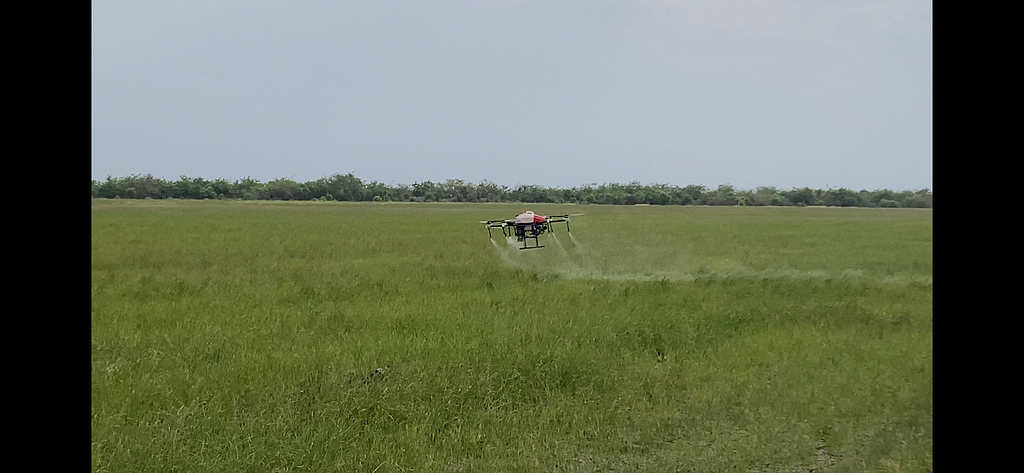
And the problem isn’t only time. Every large-scale farmer in Nigeria knows these costs:
- Labour that is hard to find and hard to manage. More hectares means more workers, more wages, and more supervision, and you still can’t watch every row.
- Uneven spraying. Some corners get too much chemical,l and some get none. You pay for the chemical either way, and you only see the mistake when the yield comes in.
- Health risk for your workers. Hours of carrying and spraying chemicals leave people exposed, especially when protective gear is scarce.
- The weather doesn’t negotiate. One heavy rain after a slow spraying schedule can wash away money you’ve already spent.
None of this means you’re a bad farmer. It means the method was never built for the size of the farm you’re running now.
Key Takeaway
A bigger farm shouldn’t mean a bigger headache every time pests show up. The question is whether your spraying method can keep pace with the land you’ve worked so hard to grow.

So here’s something to think about tonight:
If a farm of 500 hectares could be sprayed in hours instead of days, with no worker walking into the chemical and no section missed, how much would that change your next season?
Part 2 drops tomorrow. We’ll show what that looks like on a real farm, and what it takes to make it work.
Beat Drone
Originally published on Medium